For at least twenty years, I have enjoyed walking labyrinths. Labyrinths are maze-like structures that have been used as spiritual tools for centuries. For the past nine years, I’ve been walking labyrinths throughout the northeastern United States, and blogging about them. To learn more about labyrinths, check out this page at the Labyrinth Society. To find labyrinths near you, try the Worldwide Labyrinth Locator.
I was on a multiple-day labyrinth jaunt through eastern New York. The next labyrinth on my list was at someone’s private home. Nonetheless, she had listed it on the Worldwide Labyrinth Locator, so I knew she was interested in visitors. I’d emailed her first thing that morning to see if it would be okay if I stopped and walked it. She responded, “Yes, and I’ll be happy to meet you.” Oh no, I thought. I have to interact with a stranger! Why did I reach out? But as it turns out, it was an absolute joy to speak with her. We talked for about twenty minutes or so after I walked her labyrinth. She shared stories of her travels, of her gardening, of hiking on the Appalachian Trail. I’m really glad I reached out. Sometimes strangers are the best.
Anyway, onto the labyrinth. It’s called the “Lavender Labyrinth.”

It’s a classical, 7-circuit labyrinth with crushed stone path and rock walls. The neat thing about this labyrinth is that all along the walls are lavender plants. In October, they were not in bloom, and I can only imagine how beautiful and fragrant it is when they are. There were also some other flowers in addition to the lavender plants, and I was surprised that some of the roses were still in bloom.
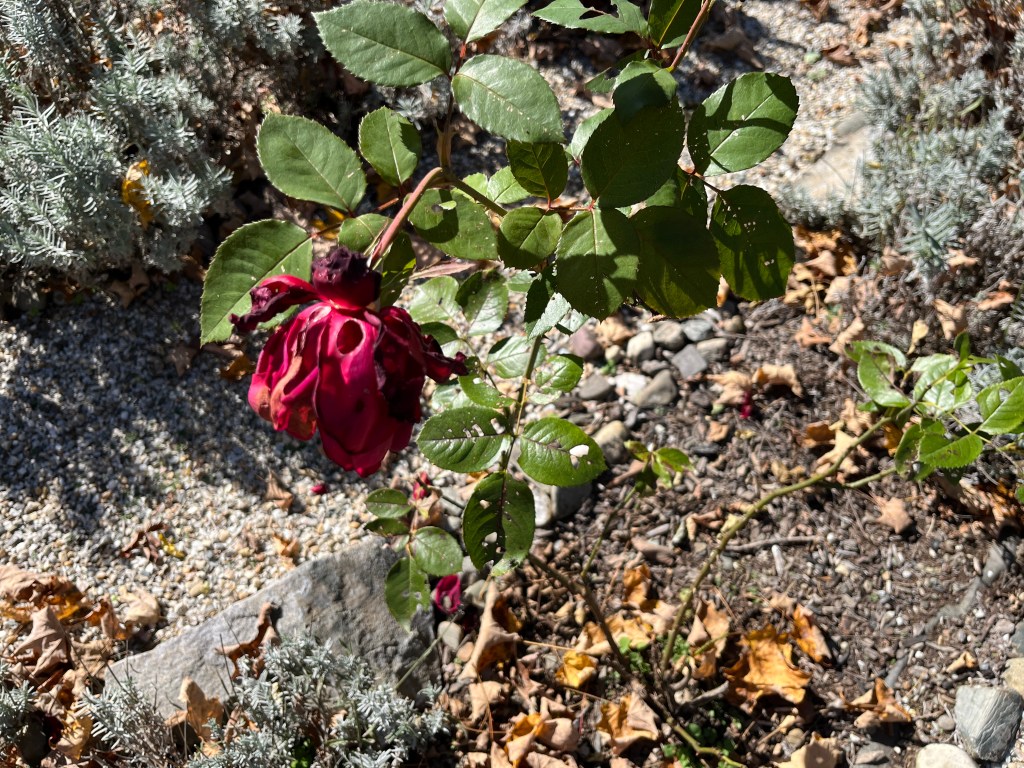
So I’d been touching on forgiveness at the last few labyrinths, so I decided to ask the question: How do I start forgiving myself?
As I walked, an answer seemed to form with each step. I can begin by using the same words for myself as I use for others, and use them in the same way. For instance, I might say that someone else is a “hopeless sinner.” And when I say that from a Lutheran perspective, I can say that about everyone – we are all sinners, we have all fallen short of what God made us to be, and we have no hope of fixing that on our own. HOWEVER, thanks to the gift of God through Christ, we are also all made saints, we are all forgiven of our sin, we are all given God’s Spirit to do amazing things. This is core Lutheran stuff, something called simul iustus et peccator (Latin for “simultaneously saint and sinner”). This is what I mean when I call someone else a sinner – it’s not a final judgment, the final judgment (which I also always say) is that they are forgiven, loved, and healed.
Anyway, I might also refer to myself as a “hopeless sinner,” but by that I usually mean that I’m worthless, horrible, dirty, and so forth. And I just leave it there. Like peccator without the iustus. And what I heard in this labyrinth is that I can start forgiving myself by refusing to use different language, or different meanings, for myself than for others.
I can start seeing myself as a whole, not as just one part. I am both sinner and saint, both good and bad, both rose and thorn. I am liminal, and that means that I am not just one thing. I am more. There is untold depth. I am more, and if I forgive myself, I might begin to see more of that more, and go even deeper.





Leave a Reply