For at least twenty years, I have enjoyed walking labyrinths. Labyrinths are maze-like structures that have been used as spiritual tools for centuries. For the past seven years, I’ve been walking labyrinths throughout the northeastern United States, and blogging about them. To learn more about labyrinths, check out this page at the Labyrinth Society. To find labyrinths near you, try the Worldwide Labyrinth Locator.
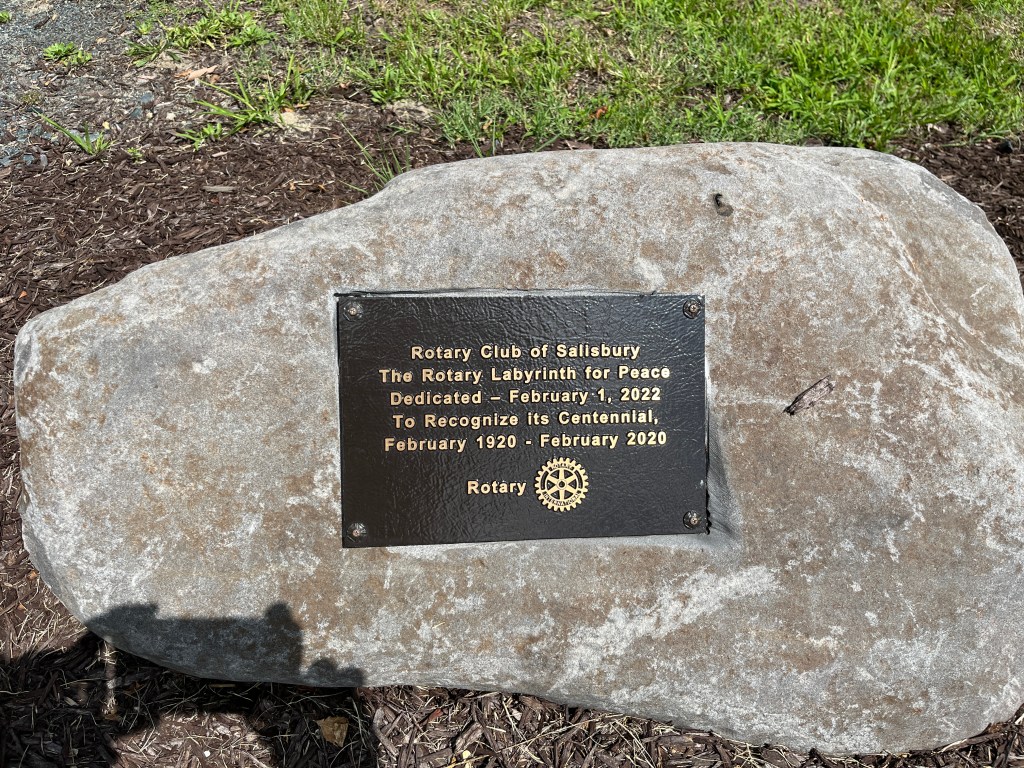
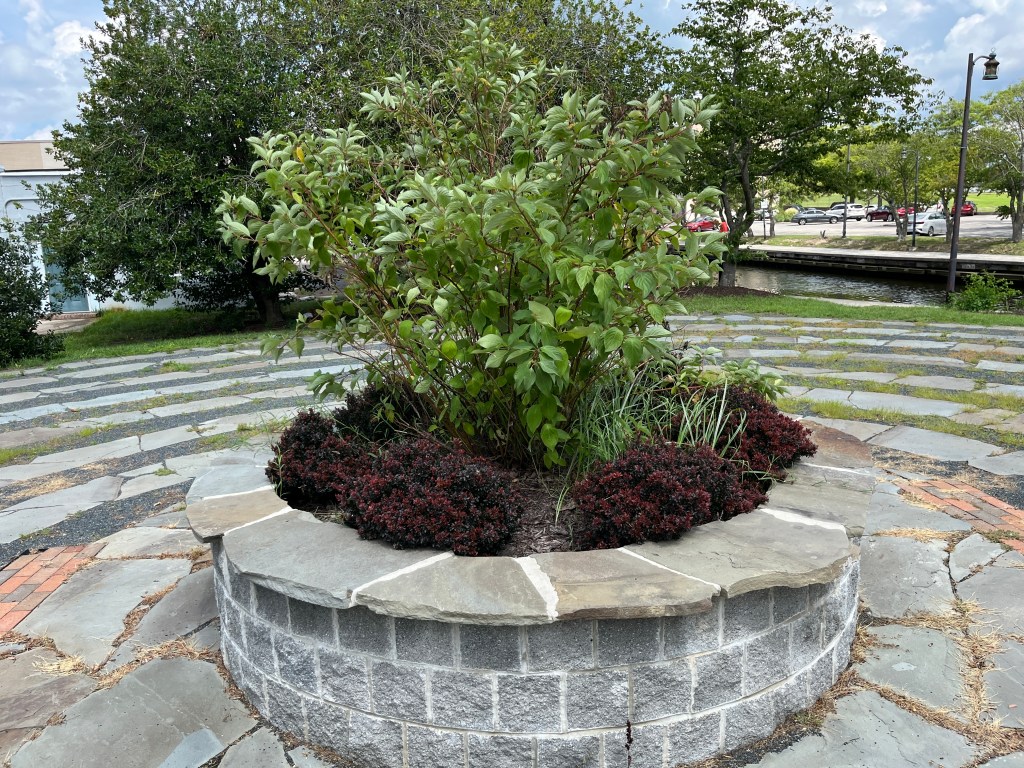
The fourth labyrinth I walked during my family’s trip to Chincoteague Island was in Salisbury, Maryland. Located adjacent to the Wicomico River as part of the city’s Riverwalk, the Rotary Centennial Labyrinth for Peace was constructed as a gift to the city from Salisbury’s Rotary club to celebrate their 100th anniversary.
It’s an enormous labyrinth – only seven circuits, but the path is wide and long. Its medieval design is laid out in an unusual fashion. The path is along inlaid stones, while crushed stones provide the walls. This was the most enjoyable labyrinth I’ve walked in a long time.

At the previous labyrinth, I explored the question of why I always feel an urge to do a particular thing when I’m at the beach: I’m always driven to walk out into the ocean and “fight the waves,” daring them to knock me down, trying to stay standing as they crash into me. I received an insightful answer, but I felt there was more to explore. So I asked the same question again of this labyrinth: Again, what’s the “fighting the waves” all about?
While walking this long labyrinth, I tried to have a conversation with my 8-year-old self, the one who was at Chincoteague Island so many years ago, and the one who I believe fought the waves for the first time back then. I wanted to ask him what he was thinking then.
The first thing I heard from him was, “They were always so angry with me,” meaning my parents. (Was that true? I know I was a very obnoxious and mischievous child, but I don’t think they were always angry.) Then he said, “You’re always so angry with me,” meaning me. (Well, I can’t deny that. I tend not to have much respect or love for who I was years ago.) So I tried to just listen.
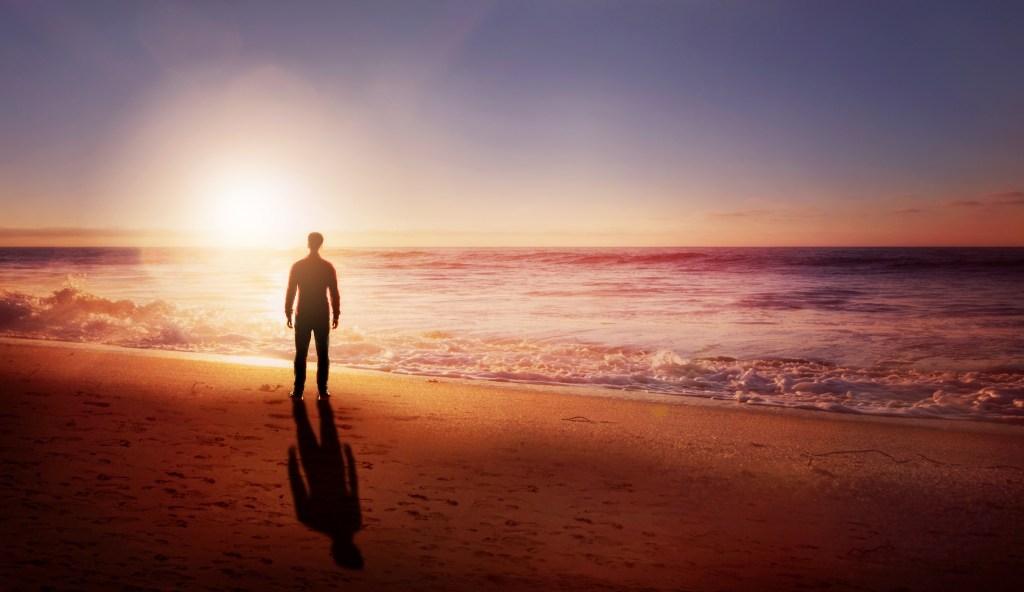
He told me that as he looked out over the ocean, he felt as though he could see the other side, that he could see Europe, that he could see where his ancestors had come from. His origin. He knew that it wasn’t literally true that he could see all the way across, but it felt so connected, since the Atlantic Ocean he stared at connected to the places my ancestors lived.
And that’s why he fought the waves. He engaged the water because it connected him to his origin. He didn’t play in the water. He didn’t observe the water. He engaged it in the only way he could think to, staring straight into it and trying to weather its waves. I said to him, “I still feel that. I still try to engage the water to connect myself with my origin.”
And that’s true, far beyond my seaside pastime. My understanding of baptism. The whole nature of my book Darkwater. The way I so often play with nostalgia. So much of this could be described as me “engaging the water to connected myself to my origin.” Heck, it was my suggestion to my family to come to Chincoteague this summer, the place I first encountered the ocean as a child. Was I unconsciously trying to engage this water again?
One more labyrinth today – I felt ready for a wrap-up.


 Scholtes-Blog
Leave a comment